San Antonio's subsurface ranges from deep alluvial deposits along the Balcones Escarpment to loose, wind-blown sands in the south, with groundwater often within 15 feet of the surface. Designing a vibrocompaction program here demands careful correlation between SPT N-values and target relative density. Our approach starts with a site-specific analysis of grain-size distribution and fines content, because clean sands densify efficiently under vibratory energy while silty zones require adjusted grid spacing. Field data from CPT testing provides continuous resistance profiles that refine the compaction depth and probe withdrawal rate, and we cross-check results against SPT drilling to calibrate the design parameters against ASTM D1586 standards.
Effective vibrocompaction design transforms loose, collapsible San Antonio sands into a uniform, dense bearing stratum capable of supporting 4,000 psf footings.
Process overview
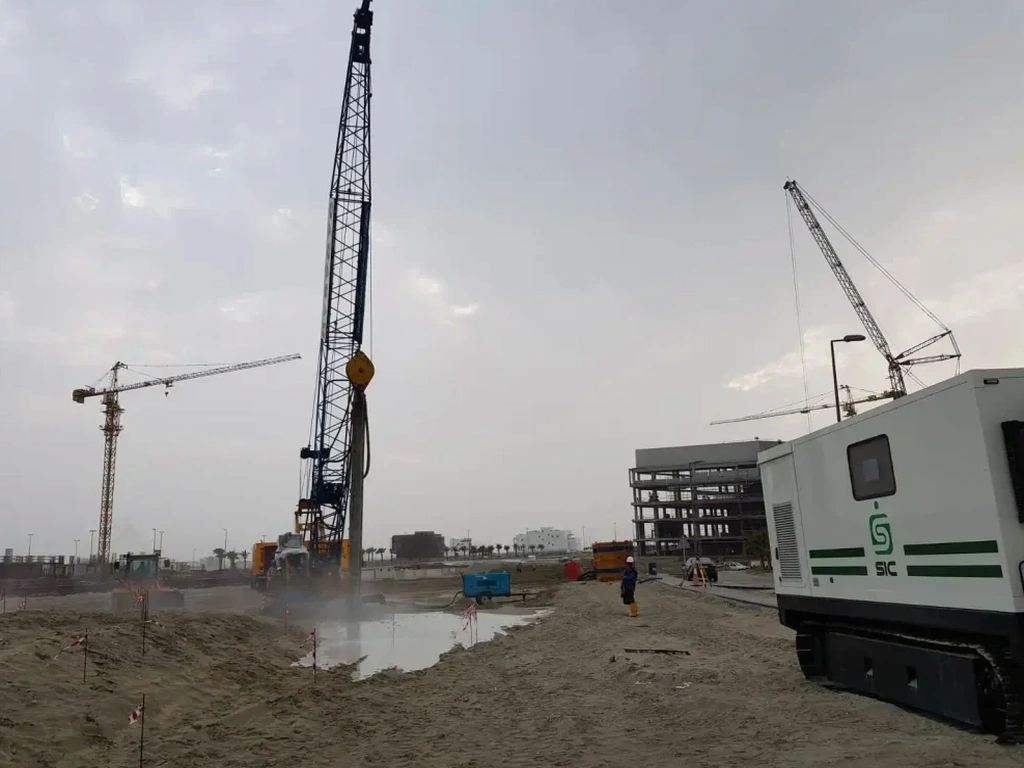
Local ground factors
The subtropical climate of South Texas alternates between prolonged drought and flash-flood events, causing groundwater to swing by 8 to 12 feet seasonally. In a vibrocompaction design, a rising water table reduces effective stress during densification and can trap pore pressure if drainage paths are insufficient—leaving the sand in a metastable state that settles later under structural load. We counter this by specifying a pre-wetting phase in dry months and by adjusting the probe's dwell time at the bottom of each stroke. Overlooking the interaction between saturation and vibratory energy transfer in San Antonio's silty terraces is the fastest route to a failed compaction test and costly rework.
Regulatory framework
ASCE 7-22 Minimum Design Loads and Associated Criteria, IBC 2024 Section 1805: Dampproofing and Waterproofing, ASTM D1586 Standard Test Method for Standard Penetration Test (SPT), ASTM D2487 Standard Practice for Classification of Soils
Additional services
Field Investigation and Soil Characterization
We direct SPT borings and CPT soundings to map loose zones, extract undisturbed samples, and run grain-size analyses per ASTM D2487 for accurate vibrocompaction feasibility across the site.
Compaction Grid and Energy Specification
Using finite element settlement models, we define the triangular or square grid, vibrator frequency, and amperage draw needed to achieve the specified relative density at each depth interval.
Post-Treatment Verification Testing
We manage the QC phase with post-compaction SPT borings and plate load tests, comparing the measured improvement with the design assumptions and adjusting the grid locally if needed.
Typical parameters
Top questions
What's the typical cost range for a vibrocompaction design package in San Antonio?
For a standard commercial lot in Bexar County, the design phase—including field investigation, laboratory classification, and the compaction specification report—generally ranges from US$1,420 to US$4,800 depending on depth, area, and the number of QC borings required.
How does the Edwards Aquifer influence vibrocompaction design?
The aquifer's recharge zone and shallow groundwater in central San Antonio mean we often design for saturated or near-saturated sands. We incorporate higher frequency vibrators and slower probe extraction to prevent pore pressure buildup that could inhibit densification.
Which soil types in San Antonio respond best to vibrocompaction?
Clean, uniform sands with less than 12% passing the No. 200 sieve show the best improvement, common in the alluvial deposits east of downtown. Silty sands with 12–15% fines can still be treated but require a tighter probe spacing and more energy per foot.
What seismic performance level does a vibrocompacted site achieve?
When designed to a relative density of 75% or higher and verified with post-compaction SPT, the treated soil typically meets the 'moderately dense' classification under ASCE 7, effectively mitigating liquefaction potential for the design earthquake in San Antonio.
What is the minimum area needed for an effective vibrocompaction job?
We can design an efficient grid for areas as small as 2,500 square feet, though the economy of scale improves significantly above 8,000 square feet. For very tight urban lots in downtown San Antonio, we evaluate alternative densification methods if crane access is constrained.