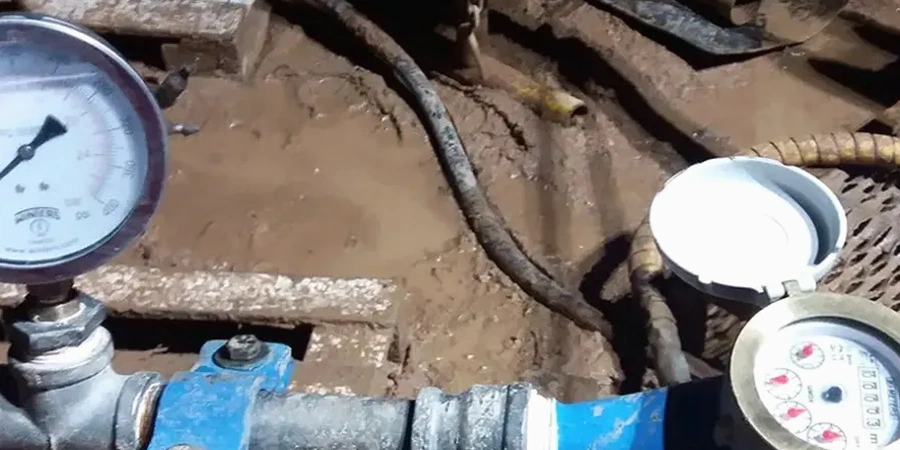
The drill rig idles beside a weathered limestone outcrop on the northwest side of the city. A technician threads the packer assembly into the borehole, double-checks the pressure gauge, and signals the water truck operator. This is a Lugeon test setup—standard procedure in San Antonio, where the Glen Rose and Edwards formations dictate everything from foundation drainage to retention pond viability. Unlike lab permeability tests on small samples, the Lefranc and Lugeon methods measure hydraulic conductivity directly within the rock mass or soil horizon, capturing fractures, joints, and secondary porosity that no remolded specimen can replicate. The local practice follows ASTM D6391 for packer tests in rock and the variable-head Lefranc procedure for soil borings. In a city where flash flooding is a real concern—San Antonio averages over 32 inches of rain annually, often in intense bursts—understanding how water actually moves through the subsurface is not a theoretical exercise. It determines whether a basement stays dry, a stormwater infiltration system works as designed, or a slope remains stable after a heavy downpour.
A single field permeability value from the right formation tells you more about site drainage than a dozen lab tests on disturbed samples.
Process overview
Local ground factors
The IBC and local San Antonio amendments require site-specific permeability data for any stormwater detention system, basement waterproofing design, or infiltration-based LID feature. Chapter 18 of the IBC references in-situ testing when groundwater control is critical to structural performance. In San Antonio, the Edwards Aquifer Recharge Zone overlay adds another layer of scrutiny—the TCEQ mandates that any excavation or injection within the recharge zone demonstrate no adverse impact on water quality, which means packer tests must use clean water and be executed without introducing drilling fluids that could migrate into the aquifer. The risk of underestimating permeability is not abstract. A subdivision built over low-permeability clay in the southern part of the city could see foundations heaving from trapped moisture, while overestimating drainage capacity in karstic terrain north of Loop 1604 can lead to sinkhole development and costly remediation. Combining permeability data with slope stability analysis is standard practice wherever cut slopes intersect water-bearing fractures, because even a modest increase in pore pressure can trigger a failure in weathered limestone.
Regulatory framework
ASTM D6391 - Standard Test Method for Field Measurement of Hydraulic Conductivity Using Borehole Infiltration, ASTM D5084 - Standard Test Methods for Measurement of Hydraulic Conductivity of Saturated Porous Materials (lab reference for correlation), USBR 6510 - Field Permeability Test in Boreholes, USACE EM 1110-2-1901 - Engineering and Design: Seepage Analysis and Control, IBC Chapter 18 - Soils and Foundations (groundwater and drainage provisions), TCEQ Edwards Aquifer Protection Program requirements
Additional services
Lugeon Packer Testing in Rock
Five-stage pressure tests in HQ or NQ boreholes using pneumatic packer systems and digital pressure transducers. Standard for dam sites, deep foundations in limestone, and quarry dewatering assessments. Interpretation includes Lugeon unit calculation and fracture flow regime classification.
Lefranc Variable-Head Testing in Soils
Falling-head or constant-head tests in cased borings through clay, silt, sand, and gravel formations. Used extensively for infiltration basin design, landfill liner verification, and basement drainage planning in the Blackland Prairie region of San Antonio.
Aquifer Recharge Zone Compliance Testing
Permeability characterization within the Edwards Aquifer Recharge and Contributing Zones, following TCEQ protocols for water quality protection. Testing uses potable water sources and includes turbidity monitoring throughout the test sequence.
Pumping Tests and Slug Tests
Larger-scale hydraulic conductivity assessment using monitoring wells or piezometers. Suitable for projects requiring aquifer transmissivity and storativity parameters, including municipal wellfield design and dewatering system sizing.
Typical parameters
Top questions
What does a field permeability test cost in San Antonio?
Field permeability testing in San Antonio typically ranges from US$620 to US$1,020 per test, depending on the method—Lefranc tests in soil borings fall toward the lower end, while Lugeon packer tests in rock with multiple pressure stages cost more due to equipment setup and longer test duration. Mobilization, traffic control if testing within city right-of-way, and water supply logistics may add to the total. A formal proposal is provided after reviewing the site location and project specifications.
When is a Lugeon test required instead of a Lefranc test?
A Lugeon test is the correct choice when the subsurface is rock—limestone, chalk, or cemented conglomerate. San Antonio's Edwards and Glen Rose formations are classic candidates. The packer isolates a specific section of the borehole and applies stepped water pressure, measuring how the rock mass and its fractures accept flow. A Lefranc test is used in soil borings where the test zone is within unconsolidated material like clay, sand, or gravel, and the simpler falling-head or constant-head configuration is adequate.
How long does a field permeability test take to complete?
A single Lugeon test in rock, with five pressure stages and stabilization at each step, usually takes 60 to 90 minutes per test interval once the packer is set. Lefranc variable-head tests in soil can be quicker—typically 20 to 40 minutes, though low-permeability clays common in San Antonio's southern side may require longer observation periods for the water level to stabilize. Setup, borehole preparation, and moving between test depths add to the overall field time.
How do San Antonio's geology and the Edwards Aquifer rules affect permeability testing?
Two main factors: first, the geological contrast between karstic limestone north of the Balcones Escarpment and expansive clay soils to the south means test methods must be matched to the formation—a Lugeon test in clay is meaningless, and a Lefranc test in cavernous limestone misses the fractures. Second, testing within the Edwards Aquifer Recharge Zone falls under TCEQ oversight, requiring clean water, turbidity monitoring, and careful control of drilling fluids to protect water quality. The field team needs to know these requirements before mobilizing.