We have seen too many foundation bids in San Antonio based on assumed bearing capacities that fall apart the moment the first auger flight hits the Glen Rose limestone. San Antonio sits right on the Balcones Escarpment, where the geology flips from stiff Edwards limestone to soft, expansive Houston Black clay within a single city block. Assuming uniform soil conditions here is a costly mistake. The Standard Penetration Test (SPT) removes that guesswork by delivering a measured N-value every 2.5 feet of depth, giving the structural engineer a defensible profile for shallow and deep foundation design. When we combine SPT data with laboratory grain-size analysis on split-spoon samples, we can distinguish between a competent gravelly clay and a troublesome fat clay that will shrink-swell through every Texas drought cycle. For sites near the Medina River floodplain, we frequently pair the SPT investigation with liquefaction screening because loose alluvial sands at shallow depth are more common than the geologic maps suggest.
In San Antonio, an uncorrected SPT N-value is just a number — a hammer-energy-corrected N60 tied to a USCS soil classification is a design parameter.
Process overview
Local ground factors
One pattern we notice repeatedly in San Antonio's older neighborhoods like Alamo Heights or King William is that pre-2000 building records rarely include SPT data below 20 feet, yet the active zone for expansive soils in Bexar County extends to 15 or even 18 feet during prolonged drought. A foundation designed on N-values from a shallow investigation may perform adequately for five years and then begin differential movement when the moisture front finally reaches the desiccated clay at depth. The IBC requires a minimum of one SPT boring per 2,500 square feet of building footprint for structures in Seismic Design Category A, but for sites underlain by the Wilcox Formation's interbedded sands and clays, we recommend doubling that density to capture lateral variability. Skipping the deep SPT profile on a commercial slab-on-grade in the IH-35 corridor is a gamble with a seven-figure remediation bill — we have been called in to diagnose enough floor slab cracks to know that the cost of a proper SPT investigation is a rounding error compared to underpinning a settled structure.
Video resource
Regulatory framework
ASTM D1586-18 — Standard Test Method for Standard Penetration Test (SPT) and Split-Barrel Sampling of Soils, ASTM D2487-17 — Standard Practice for Classification of Soils for Engineering Purposes (Unified Soil Classification System), IBC 2021 (International Building Code) — Section 1803 Geotechnical Investigations, adopted by City of San Antonio, ASCE/SEI 7-22 — Minimum Design Loads and Associated Criteria for Buildings and Other Structures, TxDOT Geotechnical Manual (current edition) — Chapter 4: Soil Surveys and Test Methods
Additional services
Standard Penetration Test (ASTM D1586)
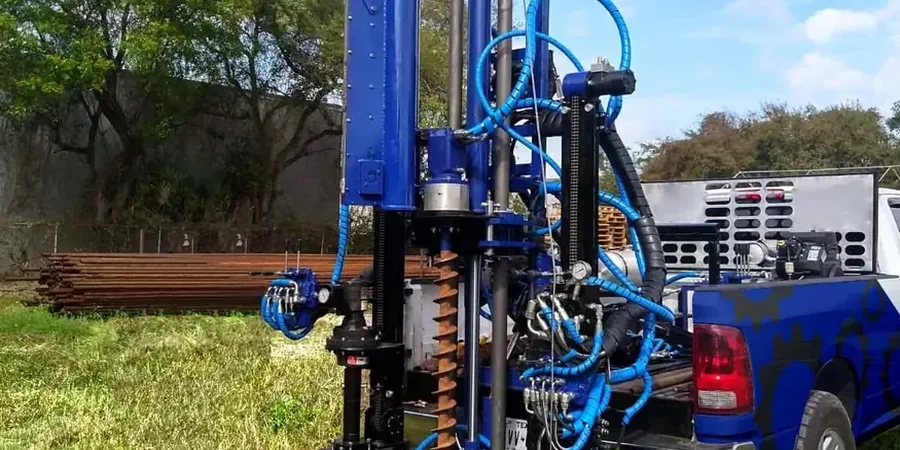
Continuous SPT sampling with automatic safety hammer, real-time energy monitoring, and N60 correction. We provide full lithologic logs with USCS classification, groundwater observation, and preliminary bearing capacity estimates for shallow footings and drilled shafts.
SPT with Rock Coring Transition
When SPT refusal is encountered on the Glen Rose limestone, we transition to NQ or HQ wireline coring in the same borehole. The combined SPT and rock quality designation (RQD) log satisfies IBC Section 1803 for structures bearing on or socketed into rock.
Liquefaction Screening (Seed & Idriss)
For sites near the Medina River, Salado Creek, or mapped Quaternary alluvium, we run SPT-based liquefaction triggering analyses using the simplified procedure. We report factor of safety against liquefaction, lateral spreading displacement, and post-liquefaction settlement.
Expansive Soil Profile Characterization
Sampling of the Houston Black and Heiden clay series at 2.5-foot intervals for Atterberg limits and swell testing. We correlate SPT N-values with plasticity index to map the active zone depth and recommend foundation types per the Post-Tensioning Institute (PTI) slab-on-ground design method.
Typical parameters
Top questions
How many SPT borings does the City of San Antonio require for a commercial building?
The City of San Antonio adopts IBC 2021 Section 1803, which requires a minimum of one boring for every 2,500 ft² of building footprint for structures on unknown fill or in Seismic Design Category A. However, for sites with documented expansive soils or variable stratigraphy — common along the Balcones Escarpment — our team typically recommends one boring per 1,500 to 2,000 ft² to capture lateral variability. The final boring layout must be stamped by a Texas-licensed Professional Engineer and submitted with the foundation permit package.
What depth of SPT investigation is normal in San Antonio?
For single-story slab-on-grade construction on competent soil, we typically advance SPT borings to 20 to 25 feet below grade, which extends at least 10 feet below the anticipated active zone for expansive clays. For multi-story structures or deep foundations (drilled shafts, belled piers), borings extend to a minimum of 1.5 times the foundation embedment depth, plus 10 feet into competent bearing material. In the Stone Oak area where limestone refusal occurs shallow, we switch to rock coring once SPT refusal is met.
What is the typical cost of SPT testing in San Antonio?
For a standard commercial lot in Bexar County, an SPT investigation with two borings to 25 feet depth, including mobilization, drilling, N60-corrected logs, and a summary report, generally falls in the range of US$610 to US$830 per boring. The total project cost depends on access conditions, traffic control requirements, utility clearance (Texas 811), and whether rock coring or laboratory testing is added to the scope. We provide a fixed-price proposal after reviewing the site address and structural loads.
How do you handle SPT refusal on the Glen Rose limestone?
When the SPT sampler achieves 50 blows in 6 inches or less than 6 inches of penetration after 10 consecutive blows, we stop SPT sampling and switch to rock coring. The driller sets casing through the overburden and uses an NQ or HQ core barrel to advance into the limestone. The rock core is photographed, logged for RQD, and tested for unconfined compressive strength (UCS). The combined SPT and rock core log provides the structural engineer with a continuous strength profile from surface to the socketed bearing stratum, fully meeting IBC 1803.5 requirements.