San Antonio sits on a geological crossroads. The Edwards Plateau limestone meets the expansive clays of the Blackland Prairie right along the Balcones Escarpment, creating unpredictable fill and compaction conditions across Bexar County. Average annual rainfall exceeds 30 inches, which means moisture-sensitive clays can swell fast and undo a compaction lift in days. When we run a field density test on your pad or utility trench, we are checking whether the contractor’s compactive effort actually matched what the proctor curve promised—something that matters more here where soil can change from shot rock to fat clay within 200 feet. A test pit investigation helps us map those transitions before density testing begins.
If you cannot prove compaction, the inspector will make you recompact—and in San Antonio’s summer heat, rework costs three times more than a density test.
Process overview
Local ground factors
The most common mistake we see on San Antonio jobsites is contractors running nuclear gauge tests on caliche-rich fill without a sand cone correlation. Caliche has variable iron content that throws off the gauge, and an inspector who spots uncorrelated readings will reject the lift. Another frequent failure is testing density on a lift that dried out under the afternoon sun—the moisture content is below optimum, the proctor reference is wrong, and the reported compaction is inflated. We have also walked onto pads where the bottom lift was never tested before burying it under three feet of select fill; the only fix was an undercut and recompaction that cost the developer weeks. Density testing is not a checkbox. It is the only way to prove the soil will carry the load without settlement you cannot fix later.
Regulatory framework
ASTM D1556: Standard Test Method for Density of Soil in Place by the Sand-Cone Method, ASTM D698: Standard Test Methods for Moisture-Density Relations of Soils (Standard Proctor), ASTM D1557: Standard Test Methods for Moisture-Density Relations of Soils (Modified Proctor), City of San Antonio Unified Development Code, Chapter 35, IBC 2024 Section 1803: Geotechnical Investigations
Additional services
Building Pad Compaction Testing
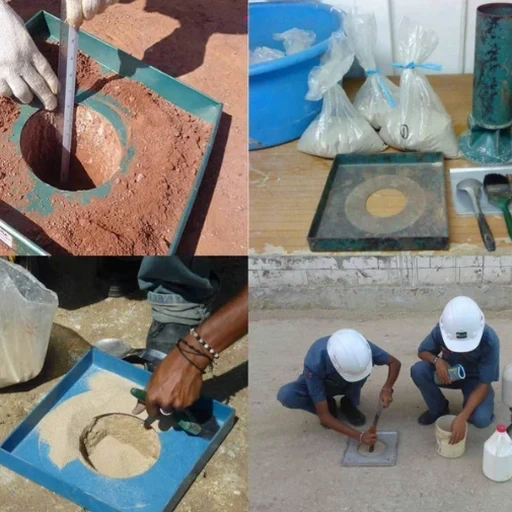
Sand cone density tests per lift on commercial and residential pads, with immediate percent compaction results against the project proctor.
Utility Trench Backfill Verification
Testing every lift in accordance with SAWS and City of San Antonio TCI standards for water, sewer, and storm drain trenches.
Parking Lot and Pavement Subgrade
Density verification on subgrade and base course before asphalt or concrete placement, including proof-rolling support.
Fill Placement Monitoring
Continuous observation during fill placement, moisture conditioning guidance, and lift-thickness control to avoid costly recompaction.
Typical parameters
Top questions
How much does a field density test cost in San Antonio?
A single sand cone density test with moisture content and a written report typically runs between US$90 and US$160, depending on site access, number of tests per day, and whether we need to run a new proctor curve for the material.
How many density tests does San Antonio code require?
The Unified Development Code references the geotechnical engineer’s recommendation, but standard practice is a minimum of one test per 1,500 square feet per lift for building pads, and one test per 50 linear feet per lift for utility trenches under public right-of-way.
Why use the sand cone instead of a nuclear gauge?
The sand cone is a direct volume-measurement method and does not need calibration for local soil chemistry. In San Antonio’s caliche and limestone fills, nuclear gauges often give biased readings unless correlated to sand cone results on the same material.
Can you test density on crushed limestone base?
Yes, as long as the maximum particle size is under 1.5 inches. For larger stone we switch to a water-replacement method or use a large-scale density ring per ASTM D5030, but most San Antonio base courses fall within sand cone limits.