The soil profile south of downtown San Antonio, near the Mission Reach, differs dramatically from the limestone hills of the northwest side. Where the San Antonio River meandered for centuries, it left behind thick sequences of soft, compressible alluvium that challenge conventional shallow foundations. Designing effective stone columns here means confronting these contrasts head-on. A site near the King William Historic District might reveal stiff clay at 12 feet, while a plot just two miles south hits fat clay with blow counts below five. We integrate CPT testing to map these transitions with continuous tip resistance data before sizing any stone column grid. The design adapts to what the subsurface actually gives, not what the county soil map assumes. San Antonio's rapid growth along the Loop 410 corridor has pushed development onto these marginal soils, making ground improvement a prerequisite rather than an afterthought.
Effective stone column design transforms San Antonio's fat clays into a composite soil mass with predictable settlement characteristics.
Process overview
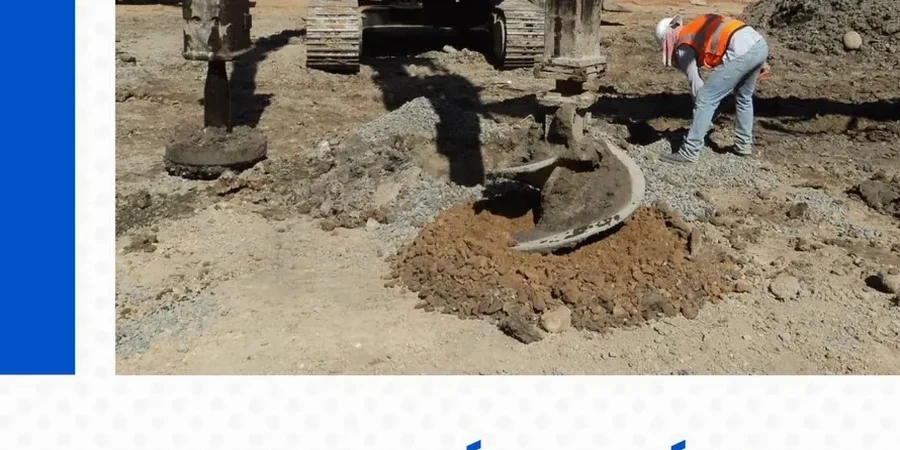
Local ground factors
In San Antonio's older floodplains, we often encounter undocumented fill that completely alters the stone column design assumptions. A recent project near the Pearl District required a complete redesign when the borehole revealed 14 feet of brick rubble and ash beneath a thin crust of intact clay. Contractors unfamiliar with these deposits risk column necking or stone contamination at the interface. The design must account for potential void collapse and specify a pre-drilling stage through the fill layer before vibro-replacement begins. Another failure mode appears when stone columns terminate above a deeper compressible stratum, creating a punching shear scenario that standard settlement calculations miss. Our protocol always extends the ground improvement zone at least two column diameters into competent bearing material. Neglecting this detail in San Antonio's interbedded alluvial profile can result in differential settlement exceeding 2 inches across a single building footprint.
Regulatory framework
ASTM D2487 – Standard Practice for Classification of Soils for Engineering Purposes (Unified Soil Classification System), ASCE 7-22 – Minimum Design Loads and Associated Criteria for Buildings and Other Structures, IBC 2021 – International Building Code, Chapter 18: Soils and Foundations, ASTM D1586 – Standard Test Method for Standard Penetration Test (SPT) and Split-Barrel Sampling of Soils, ASTM D4719 – Standard Test Methods for Prebored Pressuremeter Testing in Soils
Additional services
CPT Soil Profiling
Cone penetration testing to identify compressible layers and estimate undrained shear strength in San Antonio's clay formations.
In-Situ Permeability Testing
Field measurement of hydraulic conductivity to confirm drainage performance of stone columns, critical in Edwards Aquifer contributory zones.
Plate Load Testing
Post-installation bearing capacity verification on the composite ground, following ASTM D1194 procedures.
Settlement Monitoring
Long-term observation using settlement plates and inclinometers to validate design assumptions during construction and beyond.
Typical parameters
Top questions
What soil conditions in San Antonio make stone columns a suitable ground improvement method?
Stone columns perform well in the soft, saturated clays and silts found along the San Antonio River floodplain and its tributary creeks. These deposits often have undrained shear strengths between 300 and 700 psf, where vibro-replacement can densify the matrix and create a composite ground mass. The method also addresses the expansive clay problem by introducing vertical drainage paths that reduce seasonal moisture fluctuations in the upper soil profile.
How does stone column design account for San Antonio's shrink-swell clay behavior?
Design addresses shrink-swell behavior by extending columns through the active zone, typically 10 to 15 feet deep in Bexar County. The stone columns create a reinforced soil matrix that resists differential movement, while the granular column material provides drainage that stabilizes moisture content in the surrounding clay. The area replacement ratio is often increased near the surface to provide additional lateral confinement where seasonal movement is most severe.
What is the typical cost range for stone column design and installation in San Antonio?
For a typical commercial or light industrial project in the San Antonio area, stone column design and installation generally ranges from US$1,520 to US$4,920, depending on column depth, grid spacing, and access conditions. Sites requiring deeper treatment beyond 40 feet or with difficult access for vibro-rig equipment will trend toward the upper end of that range.
How long does the stone column design process take from investigation to final drawings?
The design process typically spans two to four weeks after completion of the geotechnical investigation. This includes time for CPT and SPT data analysis, selection of column diameter and spacing, settlement analysis using Priebe or Balaam and Booker methods, and preparation of construction specifications. Projects requiring coordination with the City of San Antonio Development Services for foundation permit review may add one additional week.
What quality control tests verify that stone columns meet the design specifications?
Quality control during construction includes recording amperage and depth during vibro-replacement to confirm refusal criteria. Post-installation verification typically uses plate load tests on individual columns and composite ground to confirm modulus of subgrade reaction. Additional SPT or CPT soundings between columns verify that the soil between elements has densified to the target N-value specified in the design.