A three-story medical office on Fredericksburg Road started showing hairline cracks six months after completion. The culprit was differential heave in the Tanque Verde clay that dominates San Antonio’s northwest corridor. The soil mechanics study had been skipped during value engineering. Our team has since run over 400 borings across Bexar County, from the rocky Edwards Plateau escarpment to the deep alluvium along the San Antonio River. The city sits on a geological boundary where Cretaceous limestone meets swelling montmorillonite clay. That mix demands more than a standard bearing capacity check. You need Atterberg limits to quantify shrink-swell potential and triaxial shear data when the water table fluctuates after a Hill Country storm. A complete soil mechanics study here merges stratigraphy with hydrology because the two are never independent in this basin.
San Antonio’s geology switches from solid limestone to expansive clay in less than a hundred yards. Your foundation design needs to know exactly where that line falls.
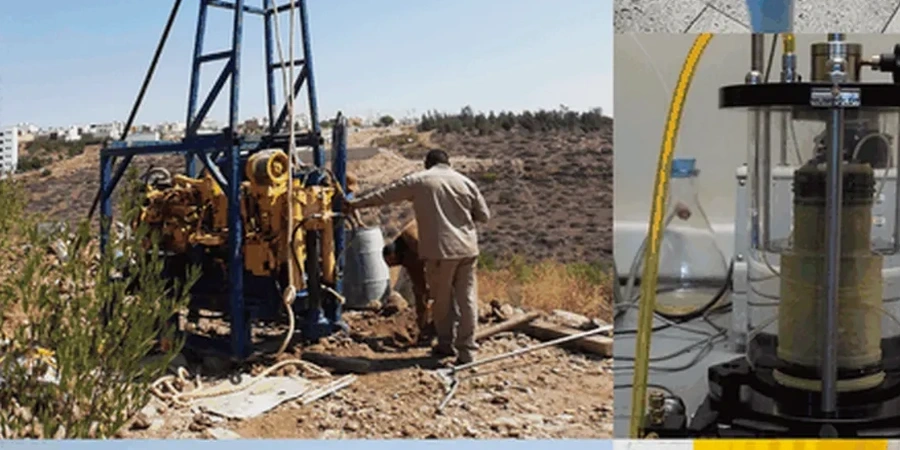
Process overview
Local ground factors
San Antonio’s first subdivisions in the 1920s were built on the flat terraces of the San Antonio River, where the clay was thin and the bearing soil was decent gravel. Postwar sprawl pushed development north into the clay belt and west onto karst limestone. The city now has documented sinkholes in the Stone Oak area and along parts of Culebra Road. A soil mechanics study that ignores the karst hazard is missing the biggest geotechnical risk in Bexar County. We run electrical resistivity lines to map voids before the drill rig moves in. When the limestone is fractured, standard SPT blow counts can be misleading because the spoon hits a vug and drops six inches. Our logs flag those anomalies and correlate them with rock quality designation. If you are building a warehouse with heavy rack loads near a mapped fault trace, differential settlement becomes a design driver, not just an afterthought.
Regulatory framework
ASTM D1586 (SPT), ASTM D2487 (USCS), ASTM D4546 (swell)
Additional services
Expansive Clay Characterization
We measure Atterberg limits, suction, and swell-consolidation behavior on undisturbed samples from the Tanque Verde and Monteola clay formations. Results feed directly into PTI slab-on-grade design parameters.
Karst & Limestone Profiling
Core drilling with RQD logging, packer permeability tests, and cross-hole seismic to map cavities in the Edwards Limestone. We flag sinkhole risk zones and recommend grouting or bridging strategies.
Foundation Load Testing
Plate load tests on shallow gravel strata and instrumented pile load tests for deep foundations near the river. We correlate the soil mechanics study data with actual load-deformation curves.
Typical parameters
Top questions
How much does a soil mechanics study cost for a typical San Antonio commercial lot?
For a half-acre commercial parcel inside Loop 410, a soil mechanics study with two borings, lab testing for expansive clay, and a foundation recommendation letter runs US$3,090 to US$4,910. The range depends on limestone depth and whether we need to core through rock. A larger site with four borings and a karst survey will push toward the upper end.
How deep do you drill for a slab-on-grade foundation in San Antonio?
We typically drill to 20 feet for residential and light commercial slabs. The first 10 feet capture the active zone where moisture cycles drive most of the heave. The lower 10 feet provide a reference on the less weathered material. If the boring hits limestone above 15 feet, we core five feet into the rock to check for voids before stopping.
Do I need a soil mechanics study if my site is on solid limestone?
Yes. Solid limestone in San Antonio is rarely continuous. Fractures, solution cavities, and clay-filled seams are common even where the outcrop looks competent. A soil mechanics study with rock coring and geophysical profiling confirms whether the limestone can support the design load without bridging over a hidden void. Skipping this step on limestone has led to sudden collapses during excavation on several Hill Country sites.