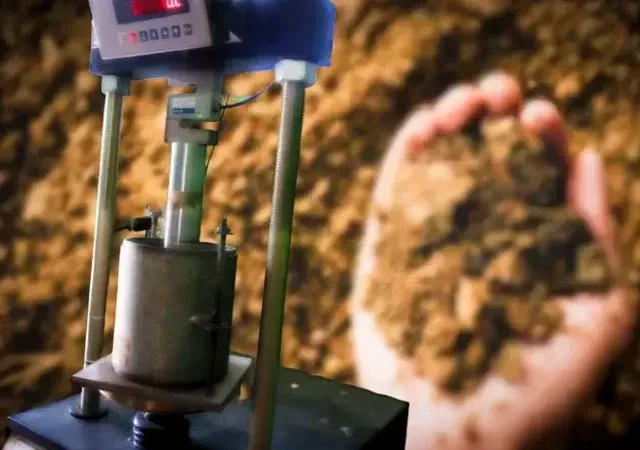
The loading press hums steadily in our lab as a cylindrical soil specimen, compacted to a specific density, meets a standardized piston at 0.05 inches per minute. This is the California Bearing Ratio test in action, measuring the resistance of a soil to controlled penetration. In a city like San Antonio, where infrastructure spreads across the transition from the limestone-dominated Edwards Plateau to the expansive clays of the Blackland Prairie, knowing your subgrade strength isn’t just a box to check—it’s the foundation of your pavement’s lifespan. The soil beneath Loop 1604 can behave completely differently than what you’d find near the Medina River floodplain. A proper grain-size analysis often accompanies our CBR work to classify these materials, and when dealing with deeper pavement sections, we may integrate findings from rigid-pavement design parameters to ensure the structural section holds up under San Antonio’s summer heat and occasional heavy downpours.
A soaked CBR value of 3 versus 8 can mean the difference between a 4-inch and a 10-inch aggregate base layer—in San Antonio's expansive clay zones, that delta drives the project budget.
Process overview
Local ground factors
The Balcones Fault Zone cuts through San Antonio, creating a geological patchwork of limestone, marl, and expansive clay. When the upper few feet of subgrade are dominated by weathered Eagle Ford Shale or Taylor Marl, the material can look rock-solid during a dry August but will slake and soften dramatically with moisture. A CBR test without proper soaking would give a false sense of security, leading to under-designed pavements that rut within the first two years. The real risk shows up on collector streets and commercial parking lots where heavy truck traffic meets a moisture-weakened subgrade. By running the ASTM D1883 soaked procedure, we replicate the saturated condition that follows a week of San Antonio’s torrential spring rains, providing a bearing value that reflects reality rather than an idealized lab state. This data pairs effectively with our plate-load-test field verification when the subgrade preparation is complete and ready for proof-rolling.
Regulatory framework
ASTM D1883: Standard Test Method for California Bearing Ratio (CBR) of Laboratory-Compacted Soils, ASTM D698: Standard Test Methods for Laboratory Compaction Characteristics of Soil Using Standard Effort, ASTM D1557: Standard Test Methods for Laboratory Compaction Characteristics of Soil Using Modified Effort, TxDOT Tex-120-E: Soil Compaction Testing (referenced for state projects)
Additional services
Soaked CBR with Swell Measurement
A four-day soaked test per ASTM D1883, including a surcharge load to simulate pavement weight. We report CBR at 0.1-inch and 0.2-inch penetration, plus the percent swell of the compacted specimen. This is the standard for TxDOT and municipal projects in Bexar County where expansive subgrades are a given.
CBR for Lime and Cement Stabilization Design
Comparative CBR testing on untreated versus stabilized soil specimens. We compact samples at the target stabilizer percentage—lime for high-plasticity clays, cement for silty materials—and test after a curing period. The before-and-after CBR values quantify the strength gain, allowing the pavement designer to justify a reduced structural section.
Typical parameters
Top questions
What does a laboratory CBR test cost in San Antonio?
A single-point soaked CBR test on a remolded sample typically runs between US$130 and US$200, depending on whether you need standard or modified Proctor compaction effort. If you are running a stabilization study with multiple stabilizer percentages and curing times, the total cost scales with the number of specimens. We can provide a line-item quote once we know the number of subgrade types and treatment options you are evaluating.
How long does the lab CBR test take from sample drop-off to report?
The soaked CBR procedure requires a 96-hour immersion period before penetration testing, so the minimum turnaround is about five working days. If we are also running the companion Proctor compaction test to establish the molding moisture and density target, that adds another day or two. Expedited testing is sometimes possible with advance coordination.
Do I need a field CBR or a lab CBR for my San Antonio project?
The lab CBR test on a remolded sample is the standard for pavement design because it gives you a worst-case soaked strength and a swell percentage—two numbers that directly feed into the AASHTO 1993 pavement design equation or the TxDOT FPS software. A field CBR test using a portable dynamic cone penetrometer is useful for quality control during construction but does not replace the lab test for the initial design phase.
Can you test crushed limestone base material with the CBR method?
Yes, we regularly test crushed limestone base from local quarries in the San Antonio area. The challenge with coarse aggregate is that the standard CBR mold is only 6 inches in diameter, so we must scalp the material to remove particles larger than 3/4 inch. We follow ASTM D1883 and note the scalping procedure in the report so the design engineer can account for the particle size adjustment.