San Antonio’s growth didn’t just spread outward—it pushed downward. As downtown lots filled in, developers started carving deeper basements into the limestone and clay, and that’s when the real geotechnical puzzles began. We often pull old Bexar County well logs before even touching a boring machine, because the Edwards Aquifer recharge zone runs right under parts of the city and you can’t design a shoring system here without understanding the perched water tables. The 2015 Frost Tower excavation, for example, hit cavities at 18 feet that nobody predicted from surface mapping alone. Our design for deep excavations in this kind of karstic terrain relies on phased investigation and real-time revision—no two blocks in San Antonio behave exactly the same way.
In San Antonio karst, a 40-foot excavation can behave like a 20-foot one or an 80-foot one depending on whether you hit a solution cavity—and you won't know without the right investigation sequence.
Process overview
Local ground factors
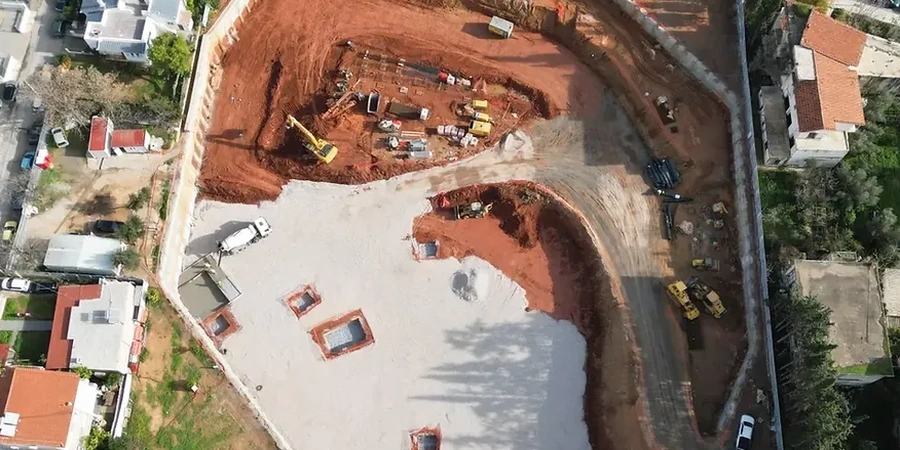
The excavator arm swings into position, the bucket teeth bite into what looks like solid limestone, and then the bottom drops out—a hidden cavity opens up and suddenly your benching plan is irrelevant. That scenario plays out more often in San Antonio than in any other Texas city because of the honeycomb dissolution features in the Glen Rose and Edwards formations. The immediate risk isn't just the hole itself; it's the loss of ground that can propagate upward and daylight as a sinkhole behind the shoring wall, pulling in utilities and pavement. We run ground-penetrating radar ahead of the cut whenever the site is within 500 feet of a mapped fault or recharge feature, and the excavation support design always includes contingency trigger levels for unexpected voids.
Regulatory framework
ASCE 7-22 Minimum Design Loads for Buildings and Other Structures, IBC 2021 Chapter 18 Soils and Foundations, ASTM D1586 Standard Test Method for Standard Penetration Test (SPT), ASTM D2487 Standard Practice for Classification of Soils for Engineering Purposes, FHWA Geotechnical Engineering Circular No. 4 – Ground Anchors and Anchored Systems
Additional services
Shoring System Design & Analysis
We develop soldier pile, secant pile, and soil nail wall designs using apparent earth pressure diagrams calibrated to San Antonio's limestone and clay stratigraphy. Each design includes staged excavation sequences and deflection estimates.
Dewatering & Groundwater Control Plans
Given the Edwards Aquifer influence, our dewatering designs incorporate pumping test data and MODFLOW-based drawdown predictions to keep the excavation dry without triggering off-site settlement.
Karst Mitigation & Grouting Programs
Where cavity probability is high, we design pre-excavation grouting programs to fill voids and reduce permeability, combined with real-time probe drilling protocols during construction.
Construction-Phase Monitoring Specifications
We write instrumented monitoring plans covering inclinometers, piezometers, and optical survey points, tied to threshold action levels specific to adjacent structures in downtown San Antonio.
Typical parameters
Top questions
What is the typical cost range for geotechnical design of a deep excavation in San Antonio?
For a complete design package—including subsurface investigation interpretation, shoring calculations, dewatering plan, and construction specifications—the fee typically ranges from US$2,050 to US$9,240 depending on excavation depth, footprint area, and proximity to adjacent structures. Multi-level basements with tiebacks in karst-prone zones trend toward the upper end of that range.
How do you handle the risk of hitting a cavity during excavation in San Antonio?
We build the investigation in phases: first a review of geologic maps and historical borehole logs from the Bexar County database, then targeted borings with rock coring, and often GPR or electrical resistivity profiles in high-risk zones. The shoring design includes contingency measures—like immediate concrete backfill or additional tieback levels—that the contractor can activate without halting the project if a void is encountered.
Which shoring system works best in San Antonio's limestone?
It depends heavily on the rock quality designation (RQD) and fracture spacing. In competent Austin Chalk with high RQD, soil nail walls or rock dowels often prove economical. In more fractured or interbedded sections of the Eagle Ford formation, soldier piles with tiebacks provide better redundancy. We don't prescribe a single system; we evaluate two or three alternatives and select based on cost, schedule, and risk tolerance for that specific block.