San Antonio grew along the Balcones Escarpment, where the Edwards Plateau gives way to the Blackland Prairie. The city’s 1.5 million residents live atop a geological boundary that challenges every foundation engineer. Limestone bedrock sits just a few feet down in the northwest, yet soft, swelling Houston Black clay dominates the southern basins. Historical districts like King William and the Pearl were built on shallow footings that have heaved and settled for over a century. Today’s taller structures, however, cannot afford that kind of movement. Deep pile foundation design in San Antonio bridges the gap between karst limestone and highly plastic clay. Our team integrates local boring logs with the latest in-situ permeability data to model the true drainage condition around the shaft, and we routinely cross-check downhole stratigraphy with seismic refraction surveys when caprock depth varies across a single pad.
In San Antonio, the difference between a stable deep foundation and a long-term liability is often the three feet of weathered rock the driller didn’t core.
Process overview
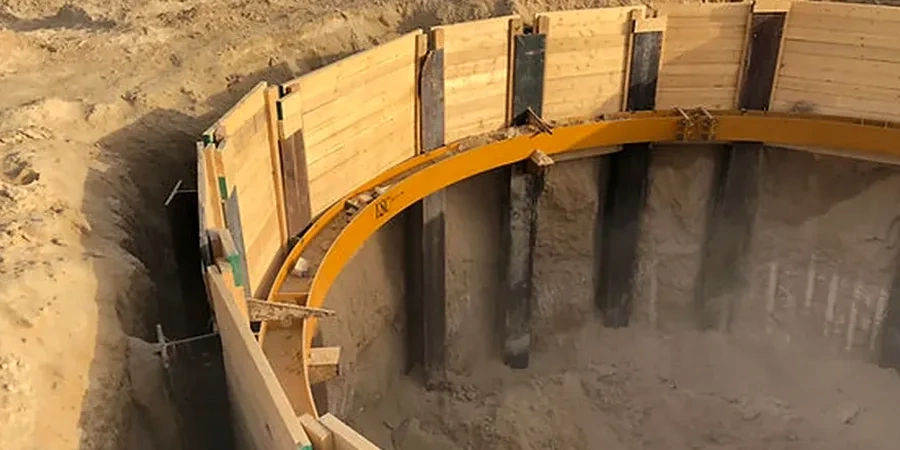
A reliable pile foundation design in San Antonio must also account for the 20-foot-thick expansive clay veneer that blankets the southeastern half of Bexar County. We specify straight-shaft drilled piers with a permanent steel casing through the active zone, then transition to a belled or rock-socketed tip depending on the depth to competent limestone. For heavily loaded columns, a plate load test on a sacrificial pier provides a direct measurement of the end-bearing modulus, replacing generic textbook values with site-specific numbers the structural engineer can actually trust.
Local ground factors
A 14-story hotel on the eastern edge of downtown San Antonio began showing distress within two years of topping out. The original geotechnical report classified the site as “stiff clay over limestone,” but it missed a 15-foot-deep solution cavity directly beneath the tower’s heaviest column line. Differential settlement cracked the post-tensioned slab and jammed the elevator rails. The repair involved drilling micro-piles through the existing mat and grouting the cavity under full-time monitoring. The expense ran well into seven figures and delayed the opening by eleven months. A thorough pile foundation design in San Antonio demands cavity probing at every pier location—not just at the borings. We map epikarst with electrical resistivity and require a minimum 10-foot rock socket into competent limestone, verified by water-pressure testing in the open hole. Skipping those steps in karst terrain is a gamble no developer should take.
Video resource
Regulatory framework
IBC 2021 (International Building Code, Chapter 18), ASCE 7-22 (Minimum Design Loads for Buildings), ASTM D1586 (Standard Penetration Test), ASTM D2487 (Unified Soil Classification System), AASHTO LRFD Bridge Design Specifications (for TxDOT projects)
Additional services
Drilled Shaft Design with Rock Socket Verification
Complete design package for straight-shaft and belled piers founded in the Glen Rose or Edwards limestone. We size the rock socket using unconfined compressive strength data from recovered core, apply the O’Neill and Reese (1999) method for side resistance, and specify probe-drilling protocols to locate hidden karst features beneath each shaft tip.
Deep Foundation Peer Review for San Antonio Commercial Projects
Independent technical review of pile designs submitted for permitting in Bexar County. We verify load-transfer curves, check the assumed active-zone depth against local soil survey data, and confirm that the karst mitigation plan satisfies the special inspection requirements of the San Antonio Development Services Department.
Typical parameters
Top questions
How much does a pile foundation design cost for a typical San Antonio commercial building?
For a standalone commercial structure in Bexar County, a complete deep foundation design package—including site investigation planning, axial and lateral capacity calculations, and construction specifications—generally runs between US$1,580 and US$7,220. The final figure depends on the number of borings, whether rock coring is required, and the complexity of the karst mitigation measures.
What depth do piles need to reach in the San Antonio area to bypass expansive clay?
In the Blackland Prairie portion of San Antonio, the active zone—where moisture-driven volume change occurs—can extend to about 20 feet below grade. We typically specify a permanent steel casing through the full active depth and socket the pier at least 10 feet into competent limestone. The exact depth is confirmed by logging the moisture content profile and the depth to the top of the Glen Rose formation at each boring location.
Does every San Antonio project need a karst investigation for pile foundations?
Not every project, but any site within the Balcones Fault Zone or mapped on the Edwards limestone should have one. We use a staged approach: desk review of the TNRIS geology map first, then a grid of electrical resistivity lines if karst features are suspected. If voids or soft zones appear, probe drilling at each pier location becomes mandatory to avoid the kind of differential settlement that has damaged several downtown structures.