In San Antonio, where the Balcones Escarpment cuts right through the northern suburbs and the southern sprawl sits on thick floodplain clays, surface mapping alone doesn't tell you much about what's happening four to twelve feet down. We've seen too many projects in the 1604 corridor scramble when a backhoe hits an unexpected lens of fat clay or a perched water table that never showed up on the desktop study. An exploratory test pit cuts through that uncertainty fast. Our team brings mechanical excavators directly to your site, opens a trench to the required depth, and lets the project geologist log the profile in real time. You get bulk samples, visual confirmation of stratigraphy, and a clear picture of moisture conditions before the structural engineer draws a single line. For deeper geotechnical data, we often pair the pit program with SPT drilling to extend the profile beyond the reach of the excavator, especially in the deeper alluvial deposits near the Medina River basin.
A test pit is the only geotechnical tool that lets the engineer see the soil profile with their own eyes before the foundation design is locked in.
Process overview
Local ground factors
The geology under San Antonio doesn't give you much warning before it changes. One lot near Alamo Heights might sit on competent limestone at three feet, while half a mile south toward downtown you hit thirty feet of plastic clay that swells and shrinks with every drought-and-deluge cycle. Skipping the exploratory test pit in these transitional zones means the geotechnical report relies on extrapolation, and extrapolation across the Balcones Fault Zone is a gamble. We've logged pits where the Eagle Ford Shale weathers to a slick, gray paste within the top five feet, a material that loses half its bearing capacity when it gets wet. If that layer ends up under a slab-on-grade without proper moisture conditioning, the floor cracks start showing up before the drywall is taped. The exploratory test pit catches these surprises early. For sites with known fill or soft organic layers, we often recommend following the pit inspection with a CPT sounding to get continuous tip resistance data across the full depth of the problem stratum.
Regulatory framework
ASTM D2487 – Standard Practice for Classification of Soils for Engineering Purposes (Unified Soil Classification System), ASTM D1586 – Standard Test Method for Standard Penetration Test (SPT) and Split-Barrel Sampling of Soils, IBC Chapter 18 – Soils and Foundations, ASCE 7 – Minimum Design Loads for Buildings and Other Structures
Additional services
Standard Exploratory Pit Logging
We open pits with a backhoe or compact excavator to the target depth specified by the geotechnical scope, log the soil profile per ASTM D2487, recover bulk and tube samples, and document groundwater conditions. The field log includes layer descriptions, plasticity estimates, and any structural features visible in the pit wall.
Pit Floor Plate Load Testing
When the foundation design requires direct modulus of subgrade reaction values, we run a plate load test on the floor of the test pit immediately after excavation. The setup uses a reaction frame and hydraulic jack to measure load-deflection behavior of the bearing stratum under controlled conditions.
Shallow Utility Clearance and Safe Dig Protocols
Before the excavator bucket breaks ground, we coordinate with Texas 811 for utility locating and review any private service maps provided by the owner. The pit layout and orientation are adjusted to avoid known lines while still exposing the target soil profile for logging.
Typical parameters
Top questions
What does an exploratory test pit typically cost in the San Antonio area?
For a standard exploratory test pit program within Bexar County, including mobilization of a backhoe or compact excavator, the field geologist's log, sample collection, and backfill, most projects fall in the range of US$490 to US$800 per pit. The final number depends on access constraints, pit depth, whether shoring is needed in sandy soils, and how many pits are included in the same mobilization day.
How deep can you go with a test pit in San Antonio soils?
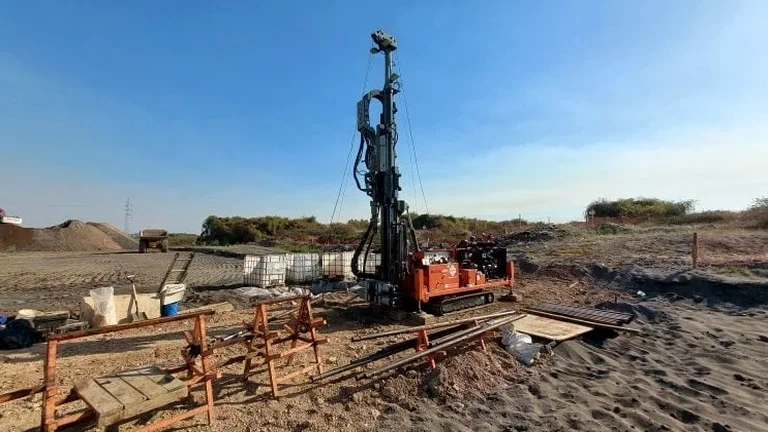
Most pits around San Antonio reach between 8 and 14 feet, which is the practical limit for a rubber-tire backhoe or a mid-size excavator without stepping the pit. In the stiff clays and weathered shale common across the area, vertical walls hold up well enough for safe logging. If we need to go deeper than about 14 feet, we switch to SPT drilling to extend the profile.
Do you handle the backfill and surface restoration after the pit is logged?
Yes, backfill is part of every test pit we execute. The excavated material goes back in compacted lifts using the excavator bucket, and we match the surface grade as closely as possible to the original contour. If the pit is in a landscaped area or a paved lot, we can coordinate with a local paving or sod contractor for final restoration.
How long does the field work take for a typical exploratory pit program?
For a single pit, from mobilization through logging, sampling, and backfill, you're looking at about half a day. A program of three to five pits on the same site usually wraps up in one full field day, assuming reasonable access and no major utility conflicts. The geotechnical report with the full log and any lab testing results follows within a week.