San Antonio sits at 650 feet elevation on the Balcones Escarpment transition zone. The 2020 census recorded 1.43 million people. Beneath that growth lies the Eagle Ford Shale and expansive Taylor Clay. Foundation performance here is not uniform. It shifts block by block. Our shallow foundation design work addresses bearing capacity failure and differential settlement directly. We analyze soil-structure interaction for spread footings and mat foundations. The geotechnical report specifies allowable bearing pressures, expected settlement magnitudes, and subgrade modulus values. Each parameter ties back to site-specific borings. No generic assumptions. The plate load test provides direct modulus input when soil variability demands field verification beyond lab data. We correlate load-deformation curves to the foundation dimension. This avoids over-excavation and unnecessary deep foundations on competent near-surface strata.
Allowable bearing pressure on San Antonio's Taylor Clay often governs at 2,000 psf — less than half the IBC presumptive value for inorganic clay.
Process overview
Local ground factors
A tilt-wall warehouse at Brooks City Base exhibited slab corner cracking six months after occupancy. The investigation revealed differential heave from a leaking irrigation line. The original design assumed uniform moisture conditions. It did not account for the edge wetting scenario. Shallow foundations on expansive clay demand a moisture control system. The perimeter grade must slope away. Roof runoff must discharge to a closed system. We specify under-slab vapor retarders and capillary breaks. Post-tensioned slabs introduce compressive stress to counteract tensile cracking from soil movement. Ribbed foundations with void forms isolate the structural slab from swelling pressures. The risk is not just cosmetic. Racking systems in warehouses can tilt. Door frames distort. Repair costs exceed the incremental design cost. A second scenario involved a school addition near the Edwards Aquifer recharge zone. The site contained solution cavities in the Austin Chalk. We performed a ground-penetrating radar survey to map anomalies. The foundation grid was adjusted to span potential voids. Reinforcement was increased 20% above code minimum.
Regulatory framework
IBC 2021: Chapter 18 (Soils and Foundations), ASCE 7-22: Minimum Design Loads and Associated Criteria, ACI 318-19: Building Code Requirements for Structural Concrete, ASTM D1586: Standard Penetration Test (SPT), ASTM D2487: Unified Soil Classification System, PTI DC10.5: Design of Post-Tensioned Slabs-on-Ground
Additional services
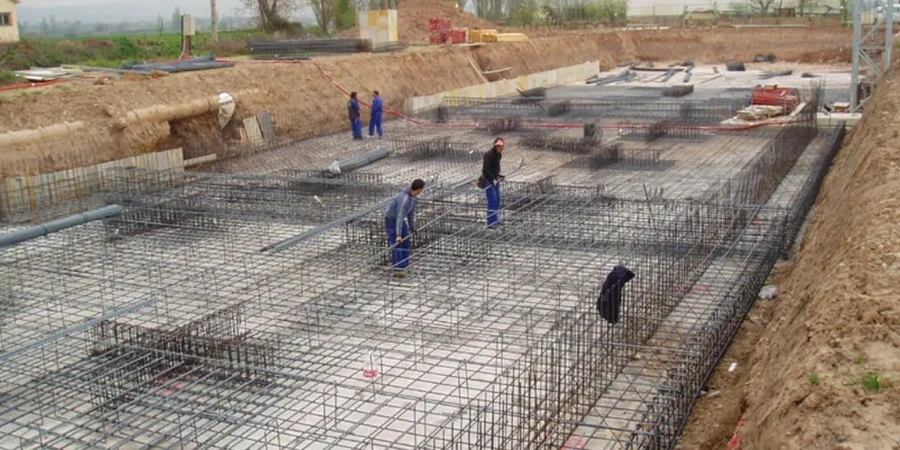
Spread Footing and Mat Foundation Design
Bearing capacity calculation per Terzaghi, Meyerhof, and Vesic methods. Settlement analysis using elastic half-space and consolidation theory. We provide reinforcement layout, embedment depth, and subgrade preparation specs.
Post-Tensioned Slab-on-Ground Design
Design for expansive soil conditions per PTI DC10.5. We calculate rib spacing, tendon layout, and stressing forces. The design includes moisture barrier details and drainage specifications to mitigate edge heave.
Typical parameters
Top questions
What is the cost for shallow foundation design in San Antonio?
Design fees typically range from US$1,710 to US$3,540. The fee depends on foundation type, total square footage, and complexity of the geotechnical report. A simple slab-on-grade for a single-family residence falls at the lower end. A mat foundation for a commercial building with irregular column grids and high wall loads sits at the upper end.
How deep must footings be in San Antonio's expansive clay?
The IBC requires a minimum of 18 inches below finished grade for exterior footings. However, expansive clay often demands deeper embedment to reach consistent moisture conditions. We typically specify 24 to 36 inches in areas with high plasticity index. The depth must also consider the active zone influence and vegetation proximity.
Can I build on fill soil without deep foundations?
It depends on the fill age and compaction method. Engineered fill placed under density control can support shallow foundations. Uncontrolled fill requires verification through test pits or CPT soundings. We often recommend over-excavation and recompaction if the fill is less than 5 feet thick. Thicker fill may need ground improvement or a mat foundation to bridge soft spots.