Designing a foundation in San Antonio means acknowledging two distinct soil personalities within the same city limits. The dense, calcareous limestone of the Balcones Escarpment near Alamo Heights offers competent bearing that behaves predictably under load, while the Blackland Prairie clays stretching through the city’s southern and western corridors can swell by over 20 percent between dry summer conditions and our heavy spring storm cycles. A conventional spread footing that performs adequately on the fractured Edwards outcrops may require complete re-engineering just two miles east, where the expansive Eagle Ford formation dominates. In areas where soil reactivity varies dramatically across a single site, a raft or mat foundation system often becomes the most rational choice. CPT testing provides the continuous soil profile needed to map these transition zones, and we frequently integrate atterberg limit analysis to quantify the plasticity that drives San Antonio’s notorious foundation distress.
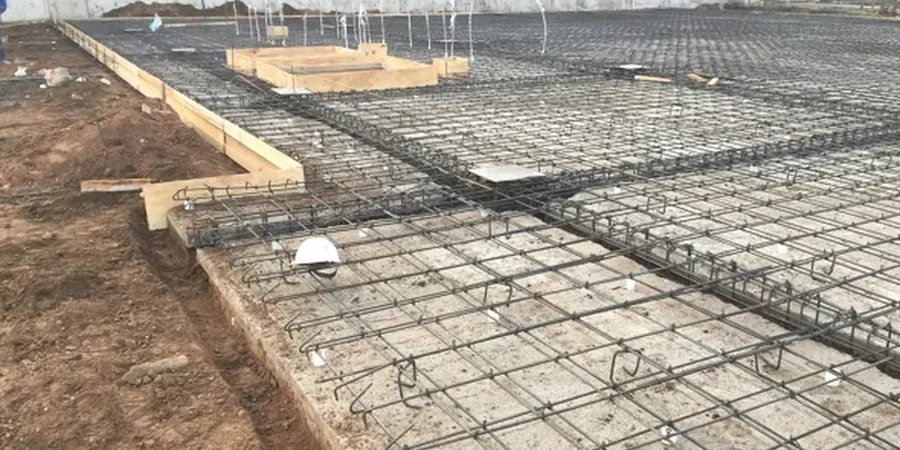
A mat foundation in San Antonio isn't just a slab on grade — it's a structural diaphragm that must accommodate both the swelling cycle of the Eagle Ford and the abrupt stiffness transitions at the Balcones Escarpment.
Process overview
Local ground factors
San Antonio’s rapid residential expansion into the IH-10 West and US 281 North corridors since the 1990s has pushed development onto marginal clay soils that earlier builders avoided. The result is a legacy of slab-on-grade failures concentrated in neighborhoods where fill placement preceded construction without adequate moisture conditioning. When a raft foundation is designed on these reclaimed sites, the primary risk shifts from bearing failure to long-term serviceability — cracks in partition walls, binding doors, and ponding on floor slabs — driven by edge-lift heave at the perimeter where moisture content fluctuates seasonally. A rigid mat can suppress differential movement, but only if the geotechnical investigation captures the depth of the active zone, which in San Antonio extends to approximately 15 feet in high-plasticity clays. Ignoring this depth leads to undersized mats that float on a swelling lens rather than bridging it.
Regulatory framework
IBC 2021 (Chapter 18 – Soils and Foundations), ASCE/SEI 7-22 (Minimum Design Loads and Associated Criteria), ACI 318-19 (Building Code Requirements for Structural Concrete), ASTM D1586 (Standard Test Method for Standard Penetration Test), ASTM D2487 (Classification of Soils for Engineering Purposes)
Additional services
Raft Foundation Engineering
Full structural design of mat foundations with finite element modeling of soil-structure interaction, calibrated to site-specific geotechnical data from San Antonio's Eagle Ford and Edwards formations.
Expansive Soil Mitigation Design
Development of moisture control strategies, void form integration, and stiffened slab configurations that reduce heave-induced distress in San Antonio's high-PI clay zones.
Typical parameters
Top questions
What is the typical cost range for a raft foundation design on a San Antonio residential lot?
For a standard residential project in the San Antonio area, the engineering design fee for a raft or mat foundation typically falls between US$1,190 and US$4,820, depending on the slab footprint, the complexity of the soil profile, and whether the site lies within the Edwards Plateau or the more reactive Blackland Prairie region.
How deep does the geotechnical boring need to go for a mat foundation in San Antonio?
In our experience across San Antonio, borings must extend well beyond the anticipated depth of the active zone. For sites on the Eagle Ford clay, we typically specify a minimum boring depth of 25 feet, with some extending deeper if bedrock is not encountered, to ensure the mat design accounts for the full swelling stratum.
Is a raft foundation better than drilled piers for expansive soils?
It depends on the site geology. In San Antonio, where the expansive clay layer can be quite thick before hitting competent limestone, a raft foundation often provides a more cost-effective solution than deep piers because it avoids drilling through unstable shale. However, for very steep sites near the Escarpment, a combination of both may be warranted.
What quality control tests are required during mat foundation construction?
Our field team typically performs in-situ density tests using the nuclear gauge method at formation level, along with concrete cylinder breaks for compressive strength verification. For large commercial mats in San Antonio, we also recommend periodic slump and air content tests throughout the pour to maintain the specified durability against sulfate-rich native soils.