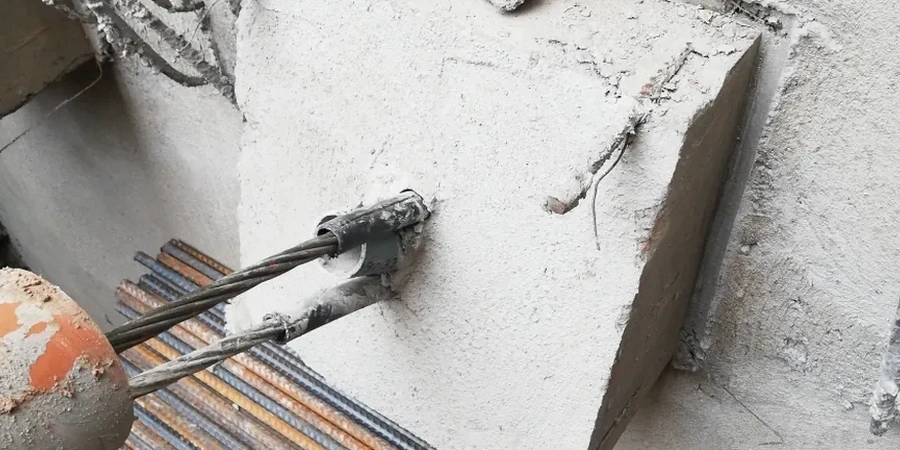
A hollow-stem auger rig positioned near the San Antonio River Walk begins the installation. The crew threads a high-strength Dywidag bar through the casing before pressure-grouting the bond zone in the Edwards Limestone. Anchor design here must account for the transition between weathered limestone, stiff clay, and the younger alluvial deposits that characterize the Balcones Escarpment. Pre-stressing the tendon with a center-hole jack locks in the design load, effectively managing lateral earth pressure for deep excavations in the downtown corridor. The 300-foot elevation change across the city introduces variable overburden stress, making thorough site investigation indispensable before any anchor layout is finalized. Engineers in San Antonio frequently combine in-situ permeability testing with anchor pull-out tests to validate bond stress assumptions in fractured rock, ensuring every strand group delivers the specified capacity for tied-back retaining walls.
In San Antonio, anchor bond stress in the Edwards Limestone can exceed 100 psi, but the fractured nature of the rock demands proof testing on every production anchor.
Process overview
Local ground factors
San Antonio's annual rainfall pattern, with intense spring storms and prolonged summer drought, creates a shrink-swell cycle in the expansive Taylor Marl that can induce secondary stresses in anchor heads. A passive anchor drilled into desiccated clay may lose 40% of its grout-to-ground bond during the wet season if the annular space was not properly sealed. The presence of karst features south of Loop 410 introduces another risk: a grout take that suddenly increases from 3 cubic feet to 15 cubic feet signals a cavity, requiring a modified staged grouting procedure to avoid excessive material loss. Creep behavior in the claystone members is monitored using a dial gauge during the 60-minute hold period, and any anchor exhibiting movement beyond 1 millimeter after the log-time stabilization is re-tensioned or replaced. The engineering team relies on the detailed stratigraphy from an SPT drilling program to identify the depth to competent rock before selecting the unbonded length and tendon configuration.
Regulatory framework
ASCE 7-22 Minimum Design Loads and Associated Criteria for Buildings and Other Structures, IBC 2021 Section 1810 - Deep Foundations (applicable to ground anchors), Post-Tensioning Institute PTI DC35.1 - Recommendations for Prestressed Rock and Soil Anchors, ASTM A722 - Standard Specification for High-Strength Steel Bars for Prestressed Concrete
Additional services
Active Anchor System Design and Proof Testing
We design pre-stressed tieback anchors for deep excavations and retaining walls, including the calculation of unbonded length, bond zone geometry, and lock-off load. Every anchor undergoes a performance test to 133% of the design load, with lift-off testing performed seven days after lock-off to verify load retention in the San Antonio subsurface conditions.
Passive Anchor and Soil Nail Wall Analysis
For slope stabilization and gravity wall reinforcement, we develop passive anchor layouts that mobilize tension through soil deformation. The analysis incorporates SPT N-values and triaxial shear strength data from the site-specific investigation, applying limit equilibrium methods to determine the required anchor density and length for the cut slopes along IH-10 and Loop 1604 corridors.
Typical parameters
Top questions
What is the cost range for anchor design services in San Antonio?
The engineering fee for a complete anchor design package, including the geotechnical analysis, load calculations, and construction specifications, typically falls between US$1,090 and US$3,560. The final cost depends on the number of anchor rows, the complexity of the subsurface profile, and whether the project requires long-term corrosion monitoring instrumentation. This does not include the installation labor or materials, which are bid separately by the specialty contractor.
How does the Balcones Escarpment geology affect anchor bond stress?
The escarpment creates a transition zone where competent limestone grades into weathered claystone over short horizontal distances. Bond stress values that are reliable on one side of a San Antonio site may drop by 30 to 50 percent just 200 feet away if the drilling encounters a karst feature or a clay-filled fissure. We address this by spacing the exploratory borings closer together in the escarpment zone and by specifying a higher percentage of proof-tested anchors to capture the spatial variability.
What is the difference between an active and a passive anchor?
An active anchor is tensioned with a hydraulic jack after the grout reaches strength, applying a compressive load to the structure immediately and preventing any movement of the retained soil. A passive anchor is grouted but not pre-stressed; it only develops resistance once the soil mass begins to deform. In San Antonio, active anchors are standard for soldier pile and lagging walls along downtown excavations, while passive anchors or soil nails are more common for permanent slope reinforcement in the northern suburban developments.
Which ASTM standards govern the materials for anchor systems?
The high-strength steel bars are specified under ASTM A722, while the seven-wire strand conforms to ASTM A416 Grade 270. Grout mix design follows ASTM C150 for Type I/II cement, with a water-cement ratio not exceeding 0.45 to limit bleed. The testing procedures, including the short-term creep test and the 10-minute load-hold protocol, are performed in accordance with the Post-Tensioning Institute's PTI DC35.1 recommendations, which are referenced by the IBC for ground anchor acceptance.