San Antonio’s growth didn’t happen by accident. The city sits on a geological boundary where the Edwards Plateau limestone meets the Blackland Prairie clays, and as the urban footprint expanded north and west, engineers kept running into the same problem: soil behavior that changes block by block. A subdivision off Loop 1604 might hit stiff caliche at three feet, then soft expansive clay half a mile away. That variability is why we run so many triaxial tests for projects here. The test gives us the shear strength parameters—cohesion and friction angle—that you actually need for bearing capacity and slope stability calculations, not generic textbook values. When a CPT test flags a weak layer at depth, the triaxial data confirms whether it’s a real problem or just a drainage artifact. San Antonio’s combination of shrink-swell clays, perched groundwater on the limestone contact, and moderate seismic hazard from the Balcones Fault Zone means conservative assumptions don’t cut it. You need lab numbers that reflect the exact material under your site.
A single triaxial curve tells you more about how San Antonio soil will actually behave under load than a dozen index tests combined.
Process overview
Local ground factors
The Eagle Ford Shale and the overlying Navarro clay dominate the geology across much of Bexar County, and both formations bring slope stability headaches. The shale weathers fast when exposed to air and water, losing strength in weeks. We’ve pulled samples from excavation sides off Highway 90 where the undrained shear strength dropped 40% between the field description and the lab test just from moisture migration during transport. That’s why triaxial data becomes non-negotiable for any cut deeper than eight feet in these materials. The numbers don’t lie—cohesion values under 500 psf with friction angles below 20 degrees mean you’re looking at a completely different excavation support plan than what the initial site walk suggested. San Antonio’s seasonal creek crossings and detention pond embankments are another place where skipping the triaxial test has cost developers real money in rework.
Regulatory framework
ASTM D4767-11: Standard Test Method for Consolidated Undrained Triaxial Compression Test for Cohesive Soils, ASTM D2850-15: Standard Test Method for Unconsolidated-Undrained Triaxial Compression Test on Cohesive Soils, ASTM D7181-20: Method for Consolidated Drained Triaxial Compression Test for Soils, IBC 2021 Section 1803: Geotechnical Investigations
Additional services
Consolidated-Undrained (CU) Triaxial Testing
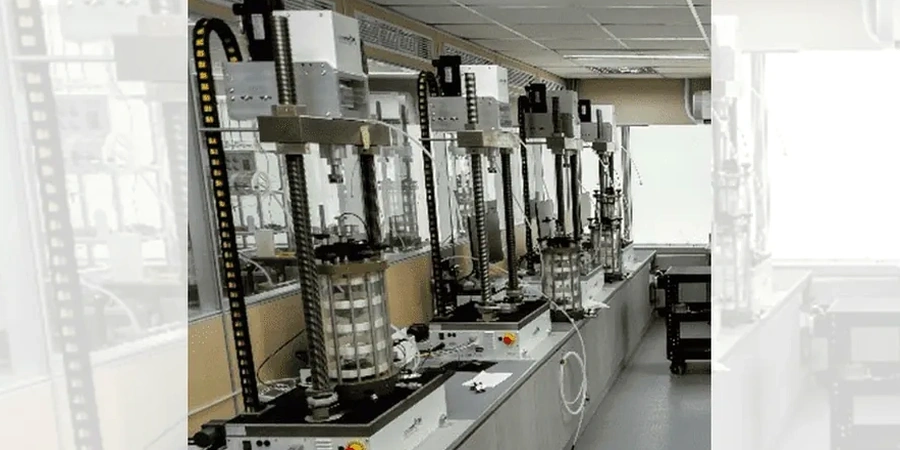
The standard choice for San Antonio foundation design. We saturate the specimen, consolidate it to the in-situ stress state, then shear undrained while recording pore pressure. You get effective stress Mohr circles and a total stress envelope—both needed when the geotechnical report has to address short-term stability and long-term drained conditions. Turnaround runs five to seven business days for a three-specimen set.
Unconsolidated-Undrained (UU) Triaxial Testing
Faster and simpler, suited for preliminary grading plans or emergency slope assessments where you need a quick undrained shear strength number. We run this frequently on fat clays from the Blackland Prairie where sample disturbance is a concern and the UU test gives a conservative lower bound for construction-phase loading.
Typical parameters
Top questions
When does a San Antonio project actually need a triaxial test instead of just a pocket penetrometer or unconfined compression?
When the foundation or slope decision has real money behind it. Unconfined compression works for stiff clays that can stand unsupported, but add sand seams, silt layers, or any fissured structure and the sample crumbles before you get a reading. Triaxial testing controls the drainage and confining stress, so you measure strength under conditions that resemble what the soil will actually see. For any structure with a factor of safety below 1.5 on slope stability, or any deep foundation where side friction matters, we recommend running at least one CU triaxial set per major soil unit.
What’s the price range for a triaxial test in San Antonio?
A three-specimen CU triaxial set with pore pressure measurement typically runs between US$1,650 and US$2,880, depending on sample condition, required strain rate, and whether we need to remold the specimen to a target density. Intact Shelby tube samples cost less to prepare than remolded specimens that need precise moisture-density control. We’ll give you a firm quote once we see the sample condition and know the testing standard your structural engineer requires.
How do you handle sample disturbance for triaxial testing on San Antonio’s expansive clays?
Sample disturbance is a real issue with the high-plasticity clays common east of downtown. We inspect every Shelby tube immediately upon arrival at the lab—if the sample shows visible cracks, voids, or moisture loss at the tube ends, we trim back aggressively before cutting the specimen. For CU tests we consolidate the specimen past the in-situ stress to collapse any disturbance-induced voids, then unload to the design confining pressure. It’s not perfect, but it produces conservative strength parameters that keep the design on the safe side.
How long does a triaxial test take from sample delivery to report?
For a standard CU triaxial set with three confining pressures, count on five to seven business days. CD tests take longer—closer to ten to fourteen days—because the shearing rate has to be slow enough to allow full drainage. UU tests are the fastest, often three to four days. Rush turnaround is available if your contractor is waiting on numbers to finalize shoring; call us before sending the samples and we’ll schedule accordingly.
Which confining pressures should I specify for a San Antonio project?
It depends on the depth and the groundwater condition. For a typical shallow footing at four feet below grade in dry clay, we’d run confining pressures around 10, 20, and 40 psi to bracket the in-situ effective stress. For a deep excavation or a pile load test scenario with deeper samples, the pressures scale up to match the overburden. If you’re not sure, send us the boring logs and we’ll recommend a testing program that meets the IBC and the project geotechnical report requirements.