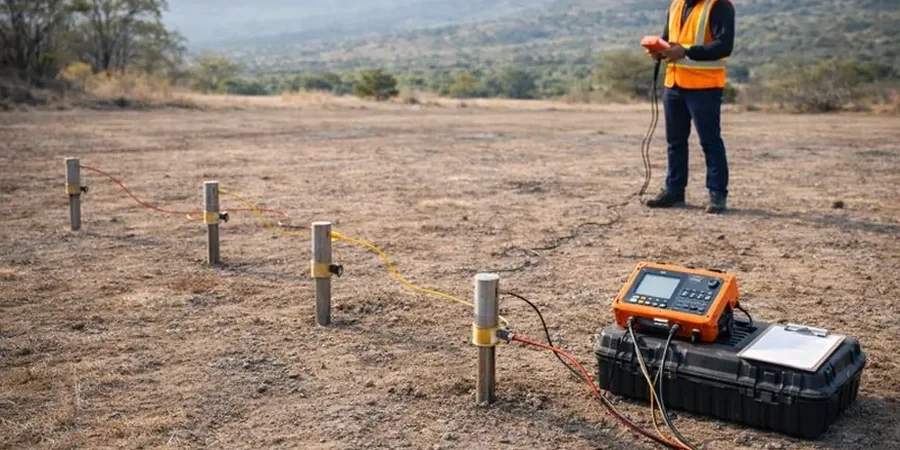
The IBC and ASCE 7 require subsurface characterization that goes beyond isolated boreholes, especially where karst features or variable clay thicknesses can compromise a foundation. In San Antonio, the Glen Rose limestone and overlying clay formations create real resistivity contrasts. Mapping those contrasts with vertical electrical sounding pinpoints zones of higher moisture, potential voids, and transitions from stiff clay to weathered rock. Our lab runs the array, collects the apparent resistivity data with a Schlumberger configuration, and delivers inverted 1D profiles tied to local stratigraphy. For projects near the Edwards Aquifer recharge zone, where TCEQ rules add scrutiny, we often combine resistivity with test pits to ground-truth the geophysical interpretation before excavation begins.
A sharp resistivity gradient in the upper 20 feet is often the first sign of a cavity or deeply weathered seam in the Glen Rose limestone.
Process overview
Local ground factors
San Antonio sits on a transition: limestone to the north and west, expansive clay to the east and south. That mix means resistivity data can be misinterpreted if the operator only reads the numbers without walking the site. Saturated clay can mimic weathered rock. A thin, dry caprock can mask a deeper low-resistivity zone. The Edwards Aquifer adds another layer: any investigation near the recharge or contributing zones falls under stricter TCEQ oversight, and a poorly executed survey that misses a void can lead to delays during excavation. We cross-check every VES sounding with available boring logs and surface geology mapping from the USGS San Antonio sheet. When resistivity suggests a sudden drop in competence, we recommend follow-up drilling rather than assuming the inversion model is perfect.
Regulatory framework
ASTM D6431 – Standard Guide for Using the Direct Current Resistivity Method, IBC 2021 – Section 1803 geotechnical investigation requirements, ASCE 7-22 – Seismic site classification and subsurface investigation provisions
Additional services
VES for Foundation Design
One-dimensional soundings at building pad locations to map depth to limestone, clay thickness, and moisture zones. Used with boring data to extend the subsurface model between drill holes.
Karst and Void Detection Surveys
Resistivity profiling along proposed footing or utility alignments where dissolution in the Glen Rose formation is suspected. We flag anomalies, estimate depth, and recommend verification points.
Groundwater and Moisture Mapping
Lateral resistivity traverses to identify perched water, preferential seepage paths, or zones of high saturation that affect excavation stability and shrink-swell behavior.
Typical parameters
Top questions
What depth can a vertical electrical sounding reach in San Antonio soils?
With a maximum AB/2 spacing of 300 feet, we can typically resolve resistivity changes down to about 60 to 80 feet in the clay-over-limestone setting common here. Actual depth of investigation depends on the resistivity contrast of the layers. A highly conductive clay near the surface will limit current penetration, while drier, resistive limestone allows deeper imaging.
How much does a resistivity survey cost for a typical residential lot?
For a single VES sounding on a residential lot in the San Antonio area, the cost typically ranges from US$630 to US$910, depending on access conditions and maximum depth required. A multi-line survey for karst screening across a larger parcel would be priced based on linear footage and electrode spacing.
Can resistivity tell the difference between saturated clay and a void?
The reference range for this service in San Antonio is US$630 - US$910. The final price depends on the project scope and volume.
How long does a VES survey take on site?
A single vertical electrical sounding to 200-foot AB/2 spacing takes about 45 to 90 minutes with a two-person crew, assuming clear ground and no major access issues. A multi-station profile along a 500-foot line can take a half day. The subsequent data processing, inversion, and interpretation in the office adds another day before the report is ready.