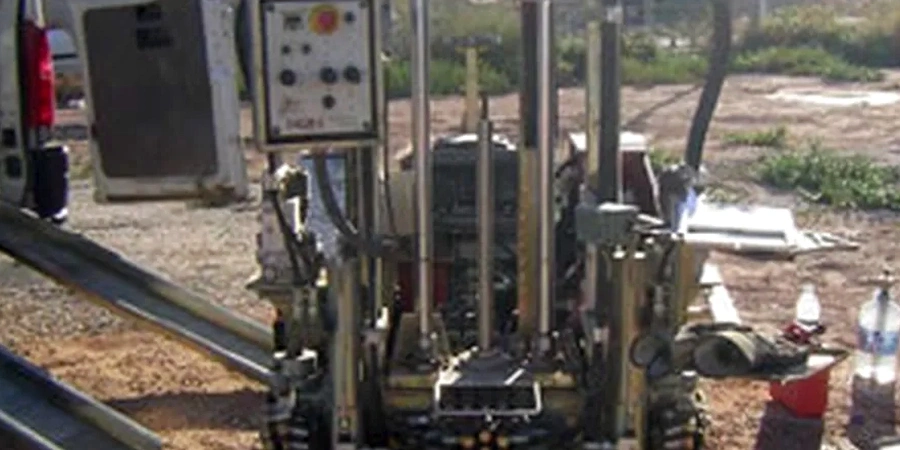
Beneath the streets of San Antonio, the geology shifts from stiff limestone of the Edwards Plateau to the expansive clays of the Eagle Ford formation and deep alluvial deposits along the San Antonio River. The city sits right on the Balcones Escarpment, where rock can be inches below the surface or hidden under 20 feet of fill. A standard SPT rig often struggles with refusal in these mixed profiles. This is where the cone penetration test delivers — pushing a instrumented cone at a steady 2 cm/s to record tip resistance, sleeve friction, and pore pressure without the disturbance of a split spoon. We use the CPT to map soft seams within limestone, find voids from karst weathering, and define the top of rock with a precision that saves foundation overruns. For sites near the recharge zone or over the Carrizo-Wilcox Aquifer, the pore pressure data is critical to understanding groundwater behavior before excavation.
In San Antonio's karst terrain, a CPT profile catches the thin void that a standard boring misses — and that one void can change a foundation design entirely.
Process overview
Local ground factors
Per IBC Chapter 18 and the Texas Commission on Environmental Quality guidelines for the Edwards Aquifer recharge zone, any subsurface investigation in western San Antonio must demonstrate that the exploration method itself won't create a conduit for surface contaminants into the groundwater. Our CPT testing satisfies this because no drilling fluid is used and the small-diameter hole self-seals in clay-rich soils. The bigger risk many projects overlook is differential settlement where a foundation spans from hard limestone onto deep residual clay — a condition common along the Balcones fault zone. A CPT profile quantifies the stiffness contrast directly through tip resistance readings, giving the structural engineer hard numbers for spring constants rather than generic presumptive values. Skip this, and you're guessing where the transition actually occurs.
Regulatory framework
ASTM D5778: Standard Test Method for Electronic Friction Cone and Piezocone Penetration Testing of Soils, ASTM D6067: Practice for Using the Electronic Piezocone Penetrometer (for groundwater applications), Robertson & Cabal (2015) SBTn classification system, IBC 2021, Chapter 18: Soils and Foundations, TxDOT TEX-132-E: Cone Penetration Test guidelines for transportation projects
Additional services
Seismic CPT (SCPTu)
Adds a geophone array to the cone assembly, measuring shear wave velocity (Vs) every meter on the way down. Essential for seismic site classification per IBC and for liquefaction assessments in the alluvial corridors east of downtown.
Piezocone with dissipation testing
Full CPTu with staged dissipation tests to measure equilibrium groundwater pressure and estimate hydraulic conductivity in the soil zones above the Edwards Aquifer. Critical for dewatering design.
Thermal conductivity profiling
For geothermal borefield design in San Antonio's growing district energy projects, we deploy a heated cone module that yields thermal conductivity and diffusivity directly from the CPT sounding.
Typical parameters
Top questions
What does a CPT test cost in San Antonio?
For a standard CPT sounding in the San Antonio area, budget between US$180 and US$220 per meter of penetration, which includes mobilization, the cone rig with operator, real-time data acquisition, and a signed engineering report with Robertson SBTn classification plots. The final meterage depends on depth to auger refusal — in limestone terrain that might be 20 feet, while in river alluvium we can reach 60 to 80 feet.
How long does a CPT take compared to an SPT boring?
A single CPT sounding to 50 feet typically takes 45 to 90 minutes of penetration time, plus setup and breakdown. The continuous push means no trip-outs for sampling — you get a complete profile in one run. By comparison, an SPT boring to the same depth with sampling every 5 feet can take half a day.
Can the CPT rig work over limestone or caliche?
Our 20-ton rig can push through weathered caliche and moderately cemented zones that would stop a smaller machine. But on massive, unweathered Edwards Limestone, the cone will refuse — that refusal depth itself is valuable data, marking the top of competent rock. If you need deeper rock coring, we coordinate with a drill rig for the rock portion.
What soil classification system do you use for CPT data?
We apply the Robertson SBTn (Soil Behavior Type, normalized) system, which uses corrected tip resistance and normalized friction ratio to assign soil behavior types. This is the standard referenced in TxDOT and USACE guidance. The classification output is not a textural grain-size curve — it's a behavioral classification, so we always recommend pairing CPT with at least one sampled boring for ground-truthing the local geology. More info.