In San Antonio, few things surprise us anymore when we open a test pit in the northeast expansion zone. The contact between the stiff clays of the Wilcox Group and the loose alluvial fills of the Balcones Escarpment creates a seismic response that varies drastically within a few hundred feet. We have seen projects where a conventional foundation analysis indicated one thing, but a subsequent CPT test revealed an impedance contrast at 12 feet that completely changed the isolation design criteria. Base isolation seismic design here is not a catalog product. It requires understanding how the 1985 Michoacán event in Mexico altered the way we think about soft soil amplification, and applying that lesson to the specific stratigraphy of Bexar County.
A base-isolated structure in San Antonio can reduce spectral acceleration at the first mode by up to 80%, but only if the site period and the isolator period are decoupled by a factor of at least 3.
Process overview
Local ground factors
The most common mistake we see in San Antonio is assuming that because the city is not on the San Andreas, the seismic risk is negligible. Then an owner discovers cracking in a concrete frame building on Loop 1604, and a subsequent MASW survey shows a fundamental site period of 0.8 seconds on a 35-foot fill over the Austin Chalk. A fixed-base structure there couples dynamically with the ground, amplifying drift to unacceptable levels. The error is not just technical; it is a financial time bomb. Retrofitting base isolators after occupancy costs three to five times more than integrating the seismic microzonation and isolation design from the schematic phase. And in essential facilities, like the hospitals in the Medical Center corridor, the ASCE 7-22 now explicitly requires performance-based procedures that cannot be met without isolation or supplemental damping.
Regulatory framework
ASCE 7-22 Minimum Design Loads and Associated Criteria for Buildings and Other Structures, IBC 2021 International Building Code, ASTM D4015 Standard Test Methods for Modulus and Damping of Soils by Resonant-Column Method
Additional services
Nonlinear Time-History Analysis for Isolated Structures
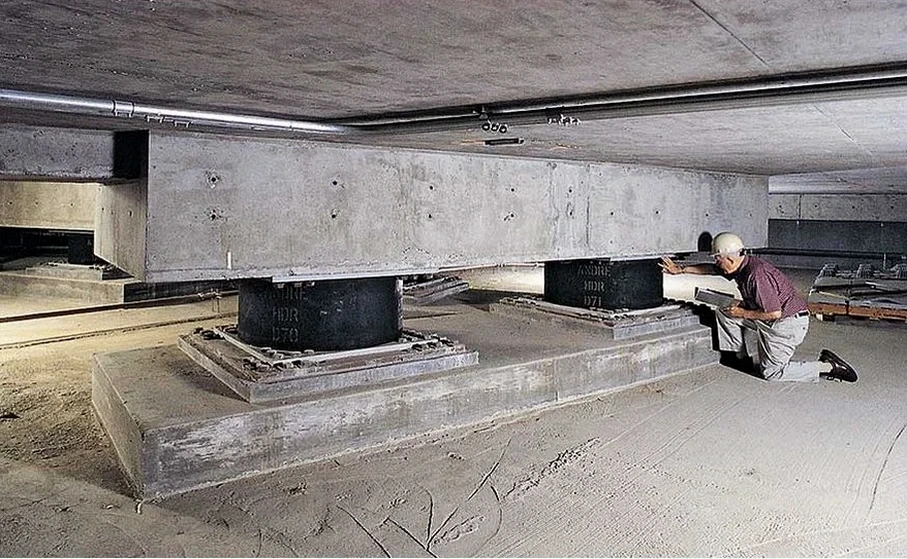
We build three-dimensional models in OpenSees and ETABS with HDRB and triple pendulum isolators, using site-specific spectra derived from PSHA studies for the Balcones fault zone. We verify MCE and DBE performance per ASCE 7-22 Chapter 17.
Site-Specific Geotechnical Characterization for Isolation Design
We execute CPTu, cross-hole seismic, and cyclic triaxial testing on Shelby tube samples from the Taylor Marl and Wilcox Formation. We determine VS30 and site class to feed the ground motion selection and scaling process.
Typical parameters
Top questions
What is the approximate cost of a base isolation seismic design for a building in San Antonio?
For a typical mid-rise structure (3 to 8 stories), the complete engineering package including site characterization, nonlinear time-history analysis, isolator specification, and peer review ranges between US$4,600 and US$7,880. The final cost depends on the complexity of the superstructure, the number of isolator units, and whether a seismic microzonation study is required for the specific lot.
When is base isolation mandatory per IBC in San Antonio?
The IBC 2021, adopted by the City of San Antonio, requires seismic isolation or other advanced protective systems for Risk Category IV structures (hospitals, fire stations, emergency operations centers) when the mapped MCER spectral response acceleration at 1 second (S1) exceeds 0.75g. In Bexar County, S1 values can reach 0.15g to 0.25g depending on the site, but the trigger for mandatory isolation is not reached for most locations. However, for essential facilities or high-value contents, owners often opt for isolation to achieve immediate occupancy performance after a design earthquake.
How do you validate the reduced seismic demand in an isolated structure?
We perform nonlinear response history analysis using a minimum of 11 ground motion pairs scaled to the site-specific spectrum per ASCE 7-22 Section 17.5. The validation includes checking isolator displacement under MCE, floor acceleration spectra for nonstructural components, and stability of the isolation system under P-delta effects. The results are compared against the fixed-base model to quantify the reduction in base shear, interstory drift, and floor accelerations.